Saturday, May 16, 2009

Lazy Korea Post

That is to say, this is my lazy post about Korea. Here's a link to pictures! We'll write more later.


[Brian's quick update]
Here's my favorite photo of the ones that I took while in Korea, if you click on the photo, it will take you to my Flickr page where you can explore more of my favorites from the trip!

Wednesday, May 13, 2009

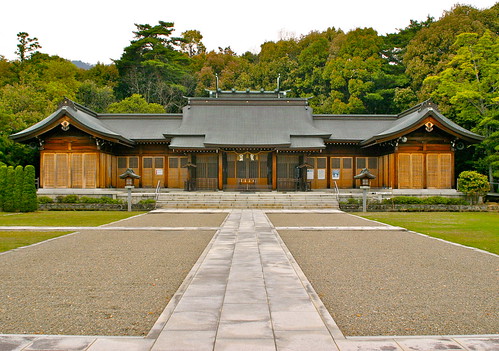
Gokoku-jinja

Gokoku-jinja is a sprawling shrine very near to Sesshu Garden and we visited both on the same day. According to this Encyclopedia of Shinto website, Gokoku-jinja is a generic name for all shrines "dedicated to the spirits of individuals who died in Japanese wars from the end of the early modern period through World War II."


Unfortunately, I really don't have much to say about it since I couldn't find much info in English about this specific shrine. The reason that this was particularly interesting to us was that the priest that we met there (who happened to be locking the place up for the day) actually took the time to perform several minutes of Taiko drumming from inside the shrine while we listened outside. His playing created a very relaxing and meditative atmosphere. Afterward he chatted with us for a while and attempted to answer several of Mia's questions.

3 quick things

Meet Yawnie, our parakeet-on-loan while we're in Japan.
He loves singing, speaks a little Japanese, and likes to sit on Brian's head.


We finally got a shot of the second crane (and a couple ducks).
Is it actually a different kind of bird?


Cute as this picture is, I can't help but wonder if my students think I'm fat!
*le sigh*

Sunday, May 10, 2009

The day that changed everything (kinda)


Anyone not living in the United States who thinks a grumpy old doctor with a cane and Viocodin addiction is attractive understands the above graphic. Hulu has viciously blocked anyone outside the US from using their services.

Ok, ok, you got me. They've always blocked foreign users, but we at least used to be able to use a service like Hotspot Shield, an IP anonymizer, to trick Hulu into thinking we were in the US. However, when we tried it tonight we got this semi-hurtful little message saying something to the effect of, "Hey, we figured out your little trick and you can't use it anymore. Nah nah nah nah nah."

Now we have two choices: use bit torrents and get the episodes illegally, but free and without commercials (see Hulu, you could have at least shown as the ads still!!), or buy episodes on iTunes. I'm happy to report that tonight we took the high road, but who knows how long that'll last. (I'm kidding.... of course we'll always be little angels.... right? *wink*)

If you have any insider info, let us know. *Sigh* Such is the life abroad. We get adventure and stories, but no TV in English.

Note: Hulu, we'd be happy to pay a monthly subscription for your services.

Thursday, May 7, 2009

Sesshu and his garden


Sesshu Toyo may only be one of the artists I have come to respect in Japan, but he is definitely the one that has most touched my heart. At a young age he was sent to live in a monastery with his uncle because his parents had passed away. One day he was caught drawing instead of doing his chores and as a punishment was tied to a pole to contemplate his wrongdoings. When a monk came to check on him later, he was surprised to find that Sesshu had drawn with his feet in the mud he created from his own tears. The other version of the story is that a monk was startled to see a mouse near Sesshu's feet, which turned out to be only a toe drawing in the dirt. Either way, the monks recognized his talents and sent him to China to learn traditional ink painting among other things.


The Five Storied Pagoda, or Gojunoto, is the beautiful piece of architecture from our previous pictures, was the child of Sesshu. I forget the significance of the five stories, but on top there is a spire with 9 metal rings, representing the 9 levels of heaven. No one enters the pagoda, because it is meant solely for meditative purposes. Additionally, there are no nails used in the entire structure and it's close to 600 years old! I apologize for this poor explanation of the structure, because a lot more was told to me, but it was a few weeks ago. Still, for some reason, Rurikoji doesn't compare to Sesshu's garden.


Sesshutei, or Sesshu's public garden, is supposedly a recreation of one of his famous landscape paintings, but I like to think he planned the garden first, then painted it, then planted it. It's composed of rocks, grass, a few trees, a pond, and a bamboo forest. The result is so moving and simultaneously immobile that you're almost forced to sit barefoot on the wooden planks of the attached house and just breathe. There's no analyzing of the artistry of the scene, no ideas of what to do next in the day, no desire to recreate the image in any way. You are simply present.

The large wooden house attached can be explored and it is full of tatami mat rooms, paintings, small shrines to unknown deities, bowls of incense, bells, and other mystical things. And yet, it seems that it's main purpose is to serve as a contrast to the effortlessness of the beauty just out the back door. The front leads to the zen rock and sand garden from the above picture. That day, we spotted several little tokage, lizards, creeping through the cracks in the steps and sunning themselves on the rocks. They were quite amusing. There's also a tea house attached, though we did not enter.

You can hike up the small mountain (hill really) behind the pond and the garden and see a small cemetery and three small shrines to more unknown deities. The walk was memorable only because an uguisu, Japanese nightingale, was singing the entire time.

It's a shame our pictures couldn't capture the full beauty of the gardens, but I guess you'll just have to come visit us and see for yourselves.


Here's a link to the local tourist guide site about this garden:

The broken ribs of ancient warriors puncture the earth's mossy skin
While the trees take turns showering gold into the pond that has slept the last 500 years,
and plans on sleeping forever.
And why should it ever wake up here?
The birds sing lullabies in the day
and the moon coos to it at night.
The bamboo simply watches from ever increasing heights.

(poem by Mia)